This page contains information about research projects, studies, and links to published articles related to consumer/survivor (peer created) arts.
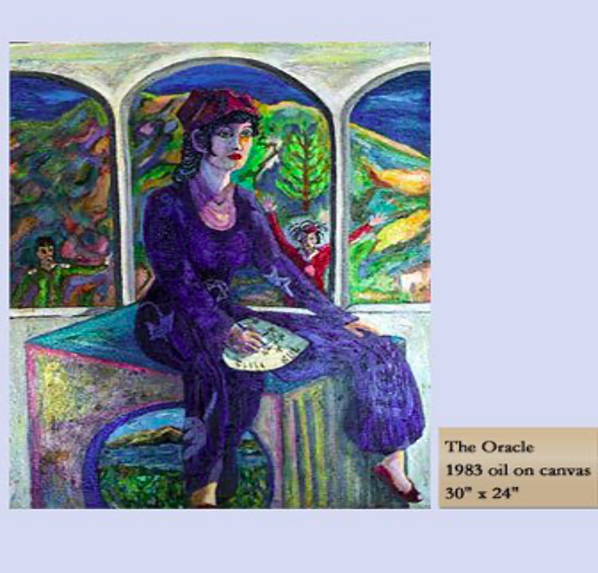
Credit: Jean Campbell, The Oracle
Well Being Project by Jean Campbell
The first research project by and for mental health clients in California.
Photography as Art for the Movement
(1995) By Jean Campbell, Ph.D., Director, Program in Consumer Studies and Training, Missouri Institute of Mental Health
Just as a writer struggles with words to find a voice that is both authentic and meaningful, and the painter attempts to guide us through layers of color to look with new eyes on familiar landscapes and faces, the photographer engages in a world of light, shutter speeds, lenses, and focal lengths to capture images that can be arresting, emotional, informative, political, manipulative, and capable of great transformations.
Photography is proletarian. You can pick up a disposable camera at the grocery store, point and click, and capture a moment in history. That photo could become high art—sensitive to the rigor of composition and other standards of aesthetic sensibility—to be displayed in an art gallery, or assembled in a collage that could also become part of a poster or book cover. It could be digitized and swim in cyberspace, appear in a newspaper to document a current event, or individual elements could be detached and reattached as graphics in various written materials. A photo can become the basis of a painting, or be embedded in the paint itself. Photos add text and texture to film and videos.
Group photos and portraits of friends and colleagues smile back at us from simple frames on the walls of our drop-in centers, board and care homes, trailers, single rooms, or rest in a back pocket to be taken out and greeted as we travel down some solitary street. They become a way to reach out to another and share a story or a lifetime. Photos talk to us of change and memory, of good times and accomplishments, and of moments of beauty. They remind us that we are not alone.
Neither is the photographer. There is an intimacy in the act of taking a picture, an exchange of the personal with the social and natural. The photographer must enter the scene, be present. This may include pushing to the front of a crowd, climbing over a hill for a better view, or convincing a large group to stand together and smile.
The casual observer of a photograph may not reflect on the traces of the photographer’s looking, on how a personal sensitivity was revealed, a space defined, and time stopped as a conscious choice for light to interact with the chemicals on a strip of film. But, there is no way for the photographer to become invisible, only forgotten. With this intimacy comes a responsibility to honor ourselves by attending to the images we capture and capturing the images that honor our movement and us.
Therefore, it is important to support our photographers, to become photographers ourselves, and to use our work creatively and repeatedly to promote our values, dreams, and understanding of the world around us. Besides all the rules for taking good pictures and the techniques for achieving certain effects, you must first make a commitment to take photographs. It can be hard work, requiring planning, preparation, and often some courage to step forward. You should also pay attention to what you are doing in terms of the form and content of the composition. It also means noticing incidental things and intervening through the act of taking the shot to manipulate the elements of the picture. Create choices, refine and embellish the pictures that begin to speak to you. That also means taking a lot of photographs and spending time deciding which ones you like and why. Finally use what you have created in multiple ways.
When accessing the needs of a community to survive and strive, one first identifies those elements that are necessary to feed the body. However, without the photographer’s celebration of life—of chance, light, and image—a society cannot witness agony or joy in order to understand, cannot nourish hope in order to realize fragile visions. People require opportunities to laugh, to touch another, and to dream. Photography allows us to reach across the void of human struggles and gather sustenance from the comfort of others, the joy of creative expression, and the flight of the spirit as it travels beyond the grasp of temporal boundaries to a place far from home but close to the soul.
 Altered States of the Arts (Psychiatric Survivors)